

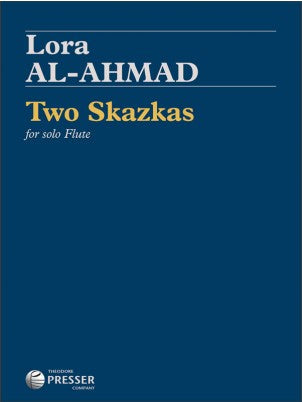
Two Skazkas (Flute Alone)
Description
Two Skazkas (Flute Alone) by Lora Al-Ahmad, Published by Theodore Presser Company.
Written and published in 2019. Includes flute part only. Written for Stefan Hoskuldssohn, duration: 7 minutes.
Bulgarian piano prodigy Lora Al-Ahmad traveled to New York City in her teens to further her training, and while at the Mannes School began studying composition with Lowell Liebermann. Among the first fruit of her fascinating talents is Two Skazkas for solo Flute. Skazka is a Russian word for story, with a particular connotation of fantasy-inspired fairy tales. Al-Ahmad's untitled skazkas enchant, leaving the actual stories to our own imaginations. Two Skazkas quickly captured the imagination of Stefan Hoskuldsson (Principal Flute of the Chicago Symphony) who has performed the work internationally.
Definitely one of the best new works of 2019, Two Skazkas by Bulgarian piano prodigy Lora Al-Ahmad was written for and championed by Stefan Hoskuldsson (Principal Flute of the Chicago Symphony). Al-Ahmad, who studied with Lowell Liebermann at the Mannes School in New York City, does not give her skazkas (Russian for “stories”) titles, leaving it to our imaginations to spin our own fantasy-inspired fairy tales.
Details
Shipping
Free shipping on US orders over $150 (automatically applied at checkout, no code needed!)
Processing time: Up to 2 business days
Need it faster? Contact us - we're here to help rush your order!
International shipping available - Please note that international orders may be subject to customs duties, taxes, and fees per your country's import regulations.
Return Policy
Due to copyright laws of the US, no refunds will be permitted for sheet music except in the sole instance of our error in fulfilling proper products.
Read more about our sales and return policy here.
Hear How It Sounds